
The evolution of programming languages in the age of AI
INSPYR Global Solutions, Technical Blog

Programming languages have always evolved alongside the needs of the technology industry.
From enterprise software and desktop applications to cloud computing and artificial intelligence, every technological shift has changed the tools developers use to solve problems. While some languages have remained relevant by adapting to new challenges, others have gradually lost prominence as the industry evolved.
Today, AI is driving another major transformation.
At INSPYR Global Solutions (IGS), we believe understanding these trends is essential—not simply to learn the latest language, but to make informed technology decisions, continue growing as professionals, and build solutions that create lasting value.
The evolution of programming languages illustrates how innovation continuously reshapes software development.
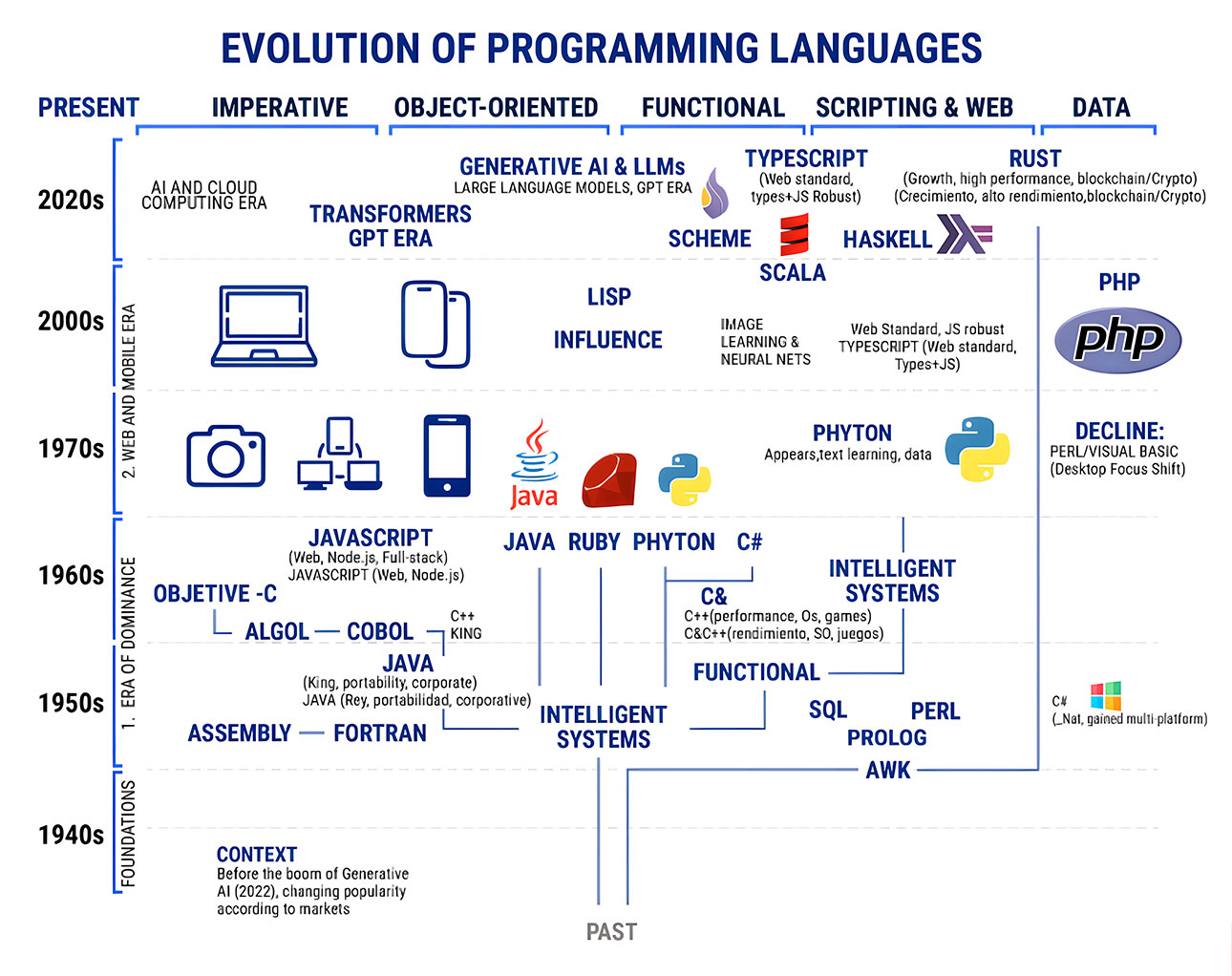
The era of enterprise software
During the early 2000s, enterprise applications dominated software development.
Organizations prioritized stability, portability, and performance, leading to widespread adoption of languages such as Java, C, C++, and later C#.
- Java became the standard for enterprise software because of its portability and extensive ecosystem.
- C and C++ remained the preferred choice for operating systems, embedded software, and high-performance applications.
- C# gained significant momentum as Microsoft’s .NET ecosystem expanded beyond Windows into cross-platform development.
The industry’s priorities at that time were clear: reliability, scalability, and enterprise adoption.
The web and mobile revolution
Between 2010 and 2020, software development shifted dramatically toward web platforms and mobile devices.
As companies invested in digital products and cloud services, developer priorities changed as well.
- JavaScript became the dominant language for web development, while Node.js enabled developers to build both front-end and back-end applications using the same language.
- Languages such as Perl and Visual Basic, once widely used for desktop development, gradually declined as browser-based applications became the new standard.
- Python began gaining traction thanks to its simple syntax, versatility, and growing adoption in automation, data science, and analytics.
This decade demonstrated that technology trends influence language adoption as much as technical capabilities.
The AI era
Since the emergence of generative AI, software development has entered a new phase.
Rather than focusing solely on application development, organizations increasingly prioritize languages that integrate naturally with artificial intelligence, cloud-native architectures, and data-driven solutions.
Today, three languages stand out.
- Python has become the leading language for artificial intelligence, machine learning, automation, and data science because of its extensive ecosystem and ease of learning.
- TypeScript has established itself as the modern standard for large-scale web development by adding strong typing and maintainability to JavaScript applications.
- Rust continues to gain popularity thanks to its performance, memory safety, and growing adoption in systems programming, cloud infrastructure, cybersecurity, and blockchain technologies.
The current trend suggests that popularity is increasingly influenced by how well a language supports emerging technologies rather than by legacy enterprise adoption alone.
Today’s programming language landscape
Several industry indexes help us understand how programming language popularity continues to evolve.
The TIOBE Index measures popularity using search engines, educational resources, and developer activity.
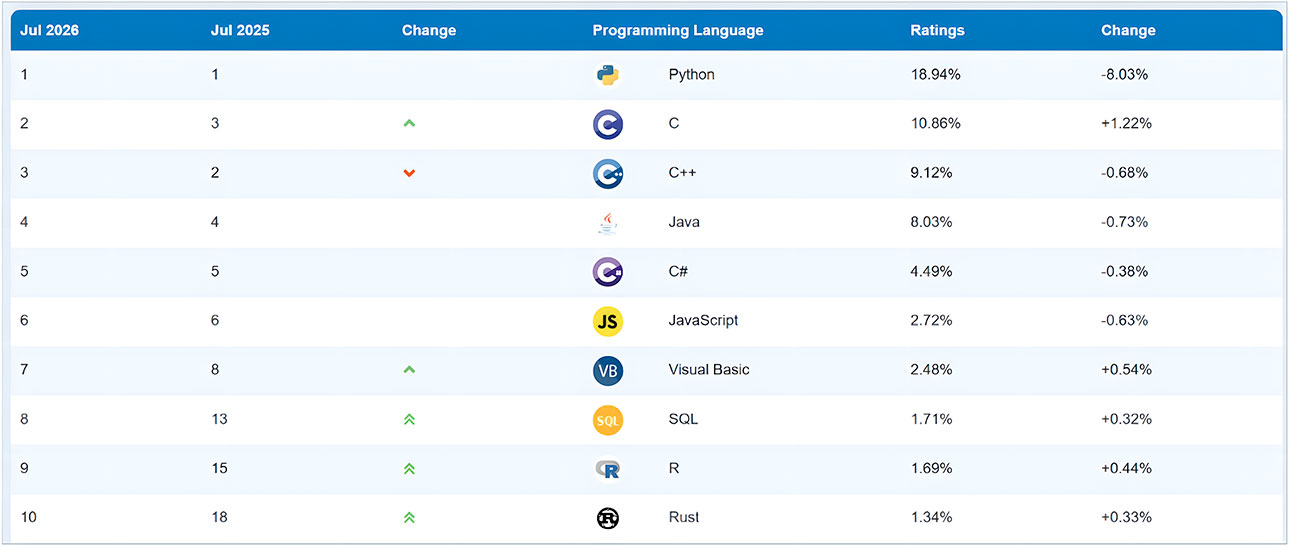
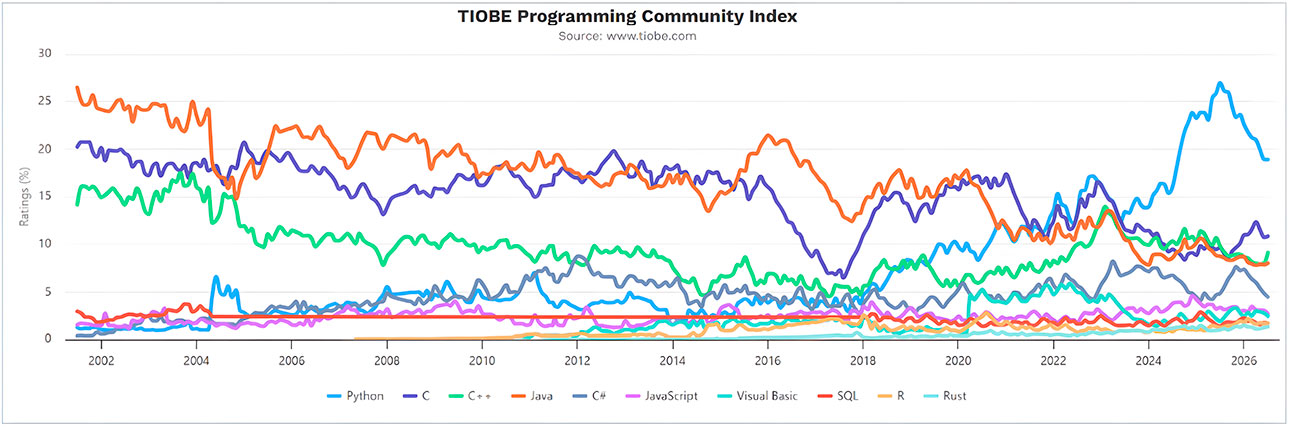
Looking beyond a single ranking, long-term historical data reveals how languages rise and fall over time as new technologies reshape the industry.
Another widely recognized indicator is the PYPL (PopularitY of Programming Language) Index, which measures popularity based on how frequently developers search for programming tutorials.
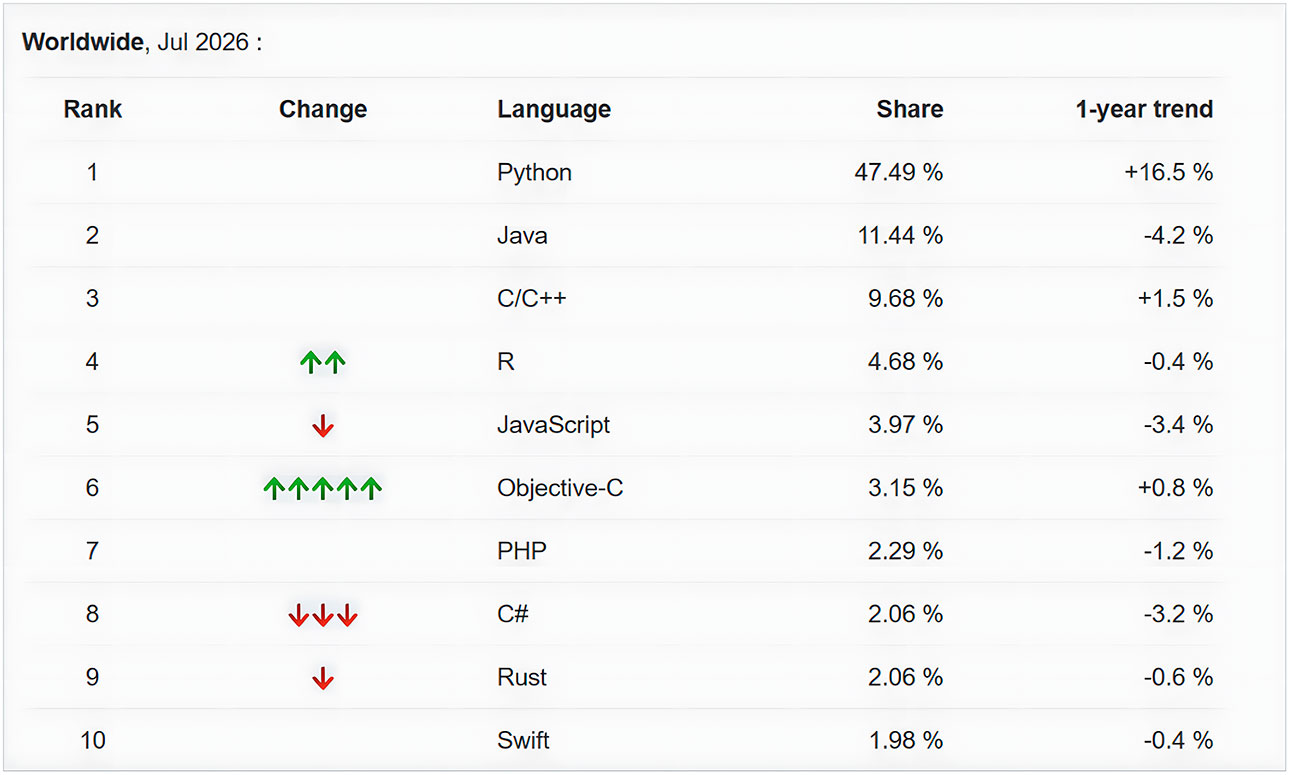
Although each index uses a different methodology, they all point toward the same conclusion: Python currently leads the market, while languages such as Java, C/C++, JavaScript, Rust, and TypeScript continue to play essential roles depending on the domain.
Popularity doesn’t replace purpose
Programming language rankings provide valuable insights into industry trends, but they should never be the only factor guiding technical decisions.
A language may be the most popular without being the best solution for every project.
Enterprise systems, embedded software, cloud-native applications, mobile development, artificial intelligence, cybersecurity, and blockchain each require different technical capabilities.
At IGS, we encourage our engineers to evaluate technologies based on business requirements, scalability, maintainability, and long-term value—not simply because a language happens to be trending.
Continuous learning means understanding why technologies evolve, not just following the latest rankings.
The best developers aren’t those who know the most popular language.
They’re the ones who know how to choose the right tool for the right problem.
If you’re passionate about modern software development, emerging technologies, and continuous technical growth, explore career opportunities at IGS and build the future of technology with us(opens in new tab).
References
Command Linux. (2026). Top programming languages 2026: Developer usage rankings and data. https://commandlinux.com/statistics/top-programming-languages/
PYPL. (2026). PYPL popularity of programming language. https://pypl.github.io/PYPL.html
Seirim. (2026). Pros and cons of the popular web and programming languages for 2026. https://seirim.com/en/resources/news/pros-and-cons-of-the-popular-web-and-programming-languages-for-2026
TIOBE Software. (2026, July). TIOBE index for July 2026. https://www.tiobe.com/tiobe-index/
YouTube. (2025). Most popular programming languages: Data from 2001 to 2025 (Animation) [Video]. https://www.youtube.com/watch?v=thS_VY-rNdg

Julio Cesar Robles Uribe
Julio Cesar Robles Uribe is a Solutions Architect at INSPYR Global Solutions with over 30 years of experience in software development across industries such as banking, healthcare, and e-commerce. He has also taught as a university professor for more than 15 years and enjoys sharing knowledge. In his free time, he likes exploring new technologies and spending time outdoors.
Share This Article
Contact Us
We’re here for you when you need us. How can we help you today?