
Do You Really Need to Know a Programming Language to Develop With AI?
INSPYR Global Solutions, News, Technical Blog

Artificial Intelligence is transforming the way software is built.
Today, developers can generate code, automate repetitive tasks, debug applications, and even create complete features with the support of AI-powered tools.
At INSPYR Global Solutions (IGS), we closely follow how these technologies are reshaping the future of software development, not only because innovation matters to us, but because we believe in empowering technology professionals to evolve alongside it.
As AI capabilities continue to grow, one important question naturally emerges:
Do developers still need to learn programming languages if AI can generate code almost automatically?
The answer depends on how AI is being used and the level of responsibility involved in the development process.
To better understand this evolution, it is important to recognize three different approaches to AI-driven development:
- AI-Assisted
- AI-Augmented
- AI-Autonomous
Each represents a different level of interaction between developers and artificial intelligence.
AI-Assisted
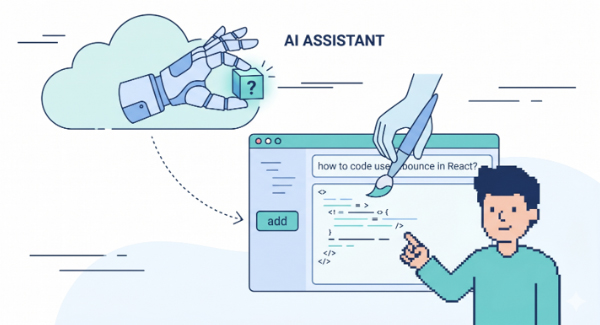
AI-Assisted development uses artificial intelligence as a support tool while the developer remains fully in control of decisions and implementation.
In this model, developers interact directly with AI platforms to ask questions, generate examples, solve bugs, or create small pieces of code. The AI acts as an assistant, but it is still the developer who evaluates, adjusts, and integrates the generated solution into the project.
This is often the first step for professionals exploring AI-powered development.
A common example of this approach is ChatGPT.
At INSPYR Global Solutions (IGS), we see this model as a valuable way to accelerate learning, improve productivity, and help developers focus more on problem-solving rather than repetitive tasks.
AI-Augmented
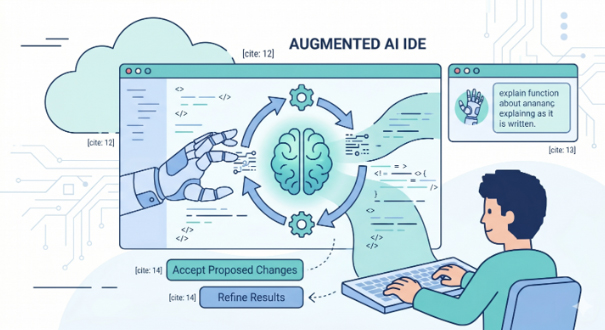
AI-Augmented development takes this interaction a step further by integrating AI directly into development environments.
In this approach, artificial intelligence not only suggests code but also analyzes the existing project context to generate functionalities, recommend improvements, explain components, and assist with feature creation in real time.
Developers can interact with their projects conversationally while maintaining full authority over what gets accepted, modified, or rejected.
This model significantly enhances productivity while still depending heavily on human judgment and technical expertise.
GitHub Copilot is one of the most recognized examples of AI-Augmented development.
At INSPYR Global Solutions (IGS), we recognize that tools like these are changing the pace of software delivery, allowing teams to innovate faster while maintaining quality standards and development best practices.
AI-Autonomous
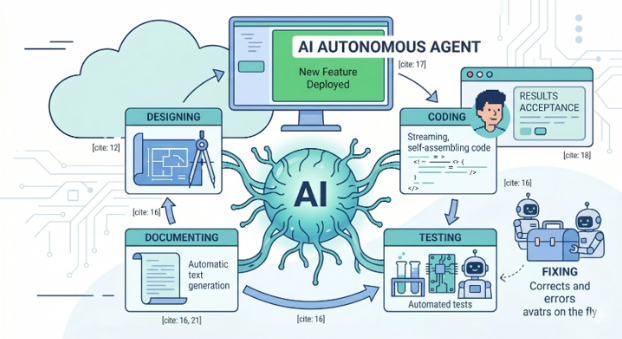
AI-Autonomous development represents a more advanced level of AI integration.
At this stage, AI can not only generate code, but also compile applications, create and execute tests, identify errors, debug issues, document processes, and continuously refine solutions based on project context and developer feedback.
Rather than functioning as a simple assistant, autonomous AI behaves more like a development partner capable of executing multiple stages of the software lifecycle.
This is typically achieved through AI agents and advanced autonomous development tools such as Devin.
However, despite these impressive capabilities, autonomous AI is not infallible.
Enterprise software development still requires human oversight, business understanding, architectural thinking, security awareness, and strategic decision-making. AI may accelerate execution, but it cannot fully replace the experience and judgment of skilled developers.
That distinction is critical.
Understanding the Difference
AI-Assisted
- Supports highly specific tasks and code generation requests.
- The developer remains fully responsible for implementation decisions.
AI-Augmented
- Interacts directly with the project and adapts to existing code context.
- Enhances developer productivity while maintaining human oversight.
AI-Autonomous
- Assists across the entire software lifecycle, including coding, testing, debugging, and documentation.
- Operates with higher autonomy but still requires technical supervision and business validation.
Conclusion
As AI continues accelerating software development, the role of developers is not disappearing — it is evolving.
For small experiments, prototypes, or low-risk projects, it is increasingly possible to create solutions through conversational AI interactions without deep programming knowledge.
However, building enterprise-level applications is a completely different challenge.
Developing secure, scalable, high-quality solutions that align with business requirements, architectural standards, and long-term objectives still requires strong technical expertise and programming knowledge.
AI can generate code.
But developers are the ones who determine whether that code is correct, secure, maintainable, and aligned with the needs of the business.
At INSPYR Global Solutions (IGS), we believe the future belongs to professionals who combine technical expertise with adaptability and continuous learning. That is why we encourage developers to embrace AI as a powerful tool — not as a replacement for critical thinking, creativity, or engineering judgment.
The most realistic answer is simple:
Learning to program remains essential. The difference is that now developers can learn, build, and innovate faster with AI by their side.
If you want to grow your technical expertise while working with emerging AI technologies and innovative global teams, discover your next opportunity at INSPYR Global Solutions (IGS).

Julio Cesar Robles Uribe
Julio Cesar Robles Uribe is a Solutions Architect at INSPYR Global Solutions with over 30 years of experience in software development across industries such as banking, healthcare, and e-commerce. He has also taught as a university professor for more than 15 years and enjoys sharing knowledge. In his free time, he likes exploring new technologies and spending time outdoors.
Share This Article
Contact Us
We’re here for you when you need us. How can we help you today?