
Why Are the Solid Principles for AI Important?
INSPYR Global Solutions, Technical Blog

As AI becomes a core part of how we build solutions at INSPYR Global Solutions (IGS), the way we write and evaluate code is evolving—but the fundamentals still matter.
Understanding principles like SOLID is not just about writing cleaner code; it’s about developing the judgment needed to work effectively in environments where AI is accelerating development. At INSPYR Global Solutions, this balance between leveraging AI and applying strong engineering fundamentals is key to how we build scalable, high-quality solutions.
For professionals looking to grow their careers, this means going beyond using AI tools and strengthening the ability to validate, adapt, and improve what is being generated. This article explores why SOLID principles remain essential in this new context and how they contribute to building better systems, and better engineers.
Most developers create applications or modify existing ones, by following good programming practices, many of which are based on their own knowledge and experience. However, over time, these applications may develop bugs or require new features, and this is where how the application was built becomes relevant.
That’s why it’s important to understand what the SOLID principles are and why they are important:
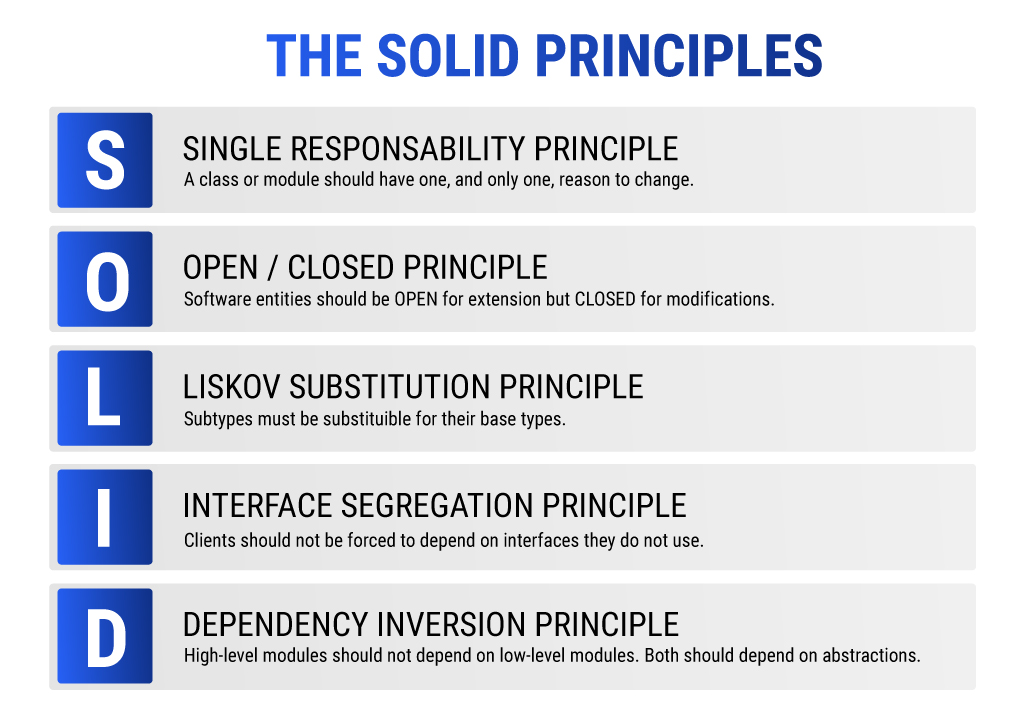
What Are the SOLID Principles?
The SOLID principles are a set of best programming practices that help developers build clearer, more organized code that is maintainable, scalable, and flexible. Their purpose is to make it easier for applications to grow, change, and adapt over time without becoming difficult to understand or modify.
Applying these principles also helps identify design problems, improve code when necessary, and build more flexible solutions to meet new changes or requirements.
Background
These principles were first presented by Robert C. Martin (also known as Uncle Bob) in the early 2000s in his paper “Design Principles and Design Patterns,” and have since been widely adopted in the software development community. However, the acronym SOLID was later introduced by Michael Feathers, who used the first letter of each principle and arranged them to form this name.
The acronym SOLID represents five fundamental principles of object-oriented programming:
- Single Responsibility Principle
- Open/Closed Principle
- Liskov Substitution Principle
- Interface Segregation Principle
- Dependency Inversion Principle
If you would like to see an explanation of each of these principles, you can visit The Clean Code Blog by Robert C. Martin.
Why Are They Important?
The phrase “good code has high cohesion and low coupling” comes from the fundamental principles of software engineering, specifically from the area of structured design.
High cohesion (intra-module: inside a module) means that the code related to a specific task or responsibility is grouped within a single module, class, or function.
Low coupling (inter-module: between modules) means that different modules or classes have minimal dependencies on each other.
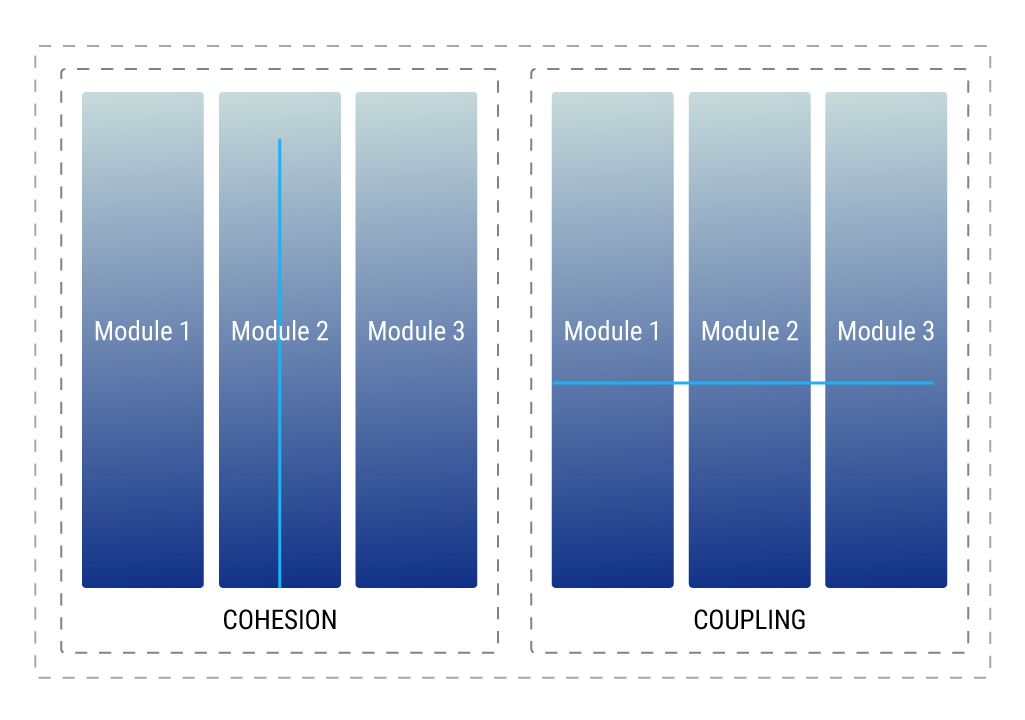
These concepts were introduced and popularized in the late 1960s and early 1970s to define the quality of software design, with the goal of reducing maintenance and modification costs.
They are attributed to researcher Larry Constantine. The formalization of these concepts was first published in the article “Structured Design” in the IBM Systems Journal in 1974, written by Wayne Stevens, Glenford Myers, and Larry Constantine.
The SOLID principles are important because they help fulfill this claim, allowing applications to be:
- More maintainable: Easier to understand and debug.
- More flexible: They adapt to changing requirements without significant restructuring.
- More extensible: New features can be added with minimal impact on existing code.
- Easier to test: Components can be isolated and tested independently, reducing the risk of side effects.
- Less prone to poor design practices: They result in cleaner, more organized codebases, preventing the accumulation of bad design decisions.
Ultimately, SOLID helps create high-quality software that is easier to evolve and has a longer lifespan.
SOLID-AI
With the integration of artificial intelligence into software development, a debate arises, since the generated code is no longer written by humans, but by AI, either with assistance (via chat) or in an automated way (with agents). It is assumed that this code is good and correct, since it follows good programming practices.
But the reality is that the quality of the code depends on the instructions given to the AI to generate it, based on our needs. Therefore, we believe it is enough to tell it something like: “Generate the code using SOLID principles and good programming practices.”
The real question is: how do we ensure that the code generated by the AI correctly applies these principles? Or, better yet, how can we validate whether the resulting code complies with them? This is where human intervention is truly important. If the person performing the review is not familiar with the SOLID Principles, how can they guarantee that the code they are reviewing complies with them?
Therefore, whoever reviews the code needs sufficient judgment and knowledge, not only of the business, but also these principles. Even if the changes are made by AI, the developer must be able to determine if they are effective and comply with the principles. Applying the SOLID principles makes it easier to maintain any future changes, not only for the AI but also for people.
Recommendations
The goal is not to eliminate AI or developers, but to empower them to use AI as a tool to enhance their capabilities. Here are some recommendations to improve and ensure the application of these principles for effective code review:
- Small Code Bits: Develop small pieces of code and don’t try to build the entire system with a single request. This way, you can review a small portion of code instead of a large number of lines or files simultaneously.
- Cross-Agents/Models: Use one agent with one model to generate the code and another agent with a different model to review the results and confirm that the principles were applied.
- Review/Rating/Iteration: Review the results yourself and ask the AI to rate your code. Ask what else can be done to improve it, assess whether changes are needed, and iterate to ensure the final results meet your standards.
These are just a few recommendations to get out started. Remember that AI is a tool, not a substitute for human oversight.
At INSPYR Global Solutions, applying principles like SOLID is part of how we ensure that the solutions we build are not only functional, but scalable and maintainable over time, even as AI becomes more integrated into development processes.
For engineers, this represents an opportunity to strengthen the kind of judgment that goes beyond generating code: understanding it, improving it, and ensuring it meets real-world standards. This is a key part of how careers grow within INSPYR Global Solutions: by combining strong fundamentals with emerging technologies.
If you’re looking to grow as an engineer while working with cutting-edge technologies and strong fundamentals, join our team today.
References
- What are SOLID Principles?
- SOLID Design Principles Explained: Building Better Software Architecture
- A Solid Guide to SOLID Principles
- The SOLID Principles of Object-Oriented Programming Explained in Plain English
- SOLID Design Principles: Hands-On Examples
- Why SOLID principles are still the foundation for modern software architecture
- What are the 5 Solid principles? What is SOLID and what is it for?
- The Clean Code Blog

Julio Cesar Robles Uribe
Julio Cesar Robles Uribe is a Solutions Architect at INSPYR Global Solutions with over 30 years of experience in software development across industries such as banking, healthcare, and e-commerce. He has also taught as a university professor for more than 15 years and enjoys sharing knowledge. In his free time, he likes exploring new technologies and spending time outdoors.
Share This Article
Contact Us
We’re here for you when you need us. How can we help you today?